
Inside the Plymouth County Most Wanted Program
The sheriff runs the closest thing Plymouth County has to a public warrant list: the official Plymouth County Sheriff Most Wanted page. It is a curated program, not a searchable export of every active warrant in the county. Read the fine print before relying on anything there. The page carries an accuracy warning and points errors to the Sheriff's Office, along with broad as-is and liability language that belongs to the program itself. Those safeguards apply to every current entry, so take them in with the content. What you will not find here is a copy of the roster. No names, photos, mugshots, addresses, birth dates, or charges are republished, because the sheriff's own page is the right home for that material. A direct link lets the agency update and correct its own information whenever it needs to.
Plymouth County Official Link Rule
A live official list changes fast. A copied version can go stale on day one. It may drop a correction or linger online with an old entry, and the sheriff's own disclaimer belongs next to the program material. So Plymouth County Most Wanted coverage points to the source, spells out its limits, and gives the safe contact paths rather than hosting a duplicate roster. The rule protects accuracy and civic use alike. Nothing gets hidden by it. Readers can open the official sheriff page above and see exactly what the agency publishes right now. Still, never rest a conclusion about warrant status on a copied card from an earlier date. Court action, service, recall, and case outcome can each land on its own timeline.
Official program only: Use the sheriff link for current Plymouth County Most Wanted content; no names, photos, mugshots, or roster are reproduced here.
How Plymouth County Most Wanted Lists Work
The sheriff's page is curated, plain and simple. It offers no search fields at all: no name, date of birth, case number, city, offense, status, or date-range lookup. There is no downloadable countywide dataset, no public API, no filter that could produce a total warrant count, and no fixed update schedule. So the honest description is narrow. The page is a sheriff-selected program with an accuracy warning attached. That missing search function matters for one big reason: absence from the list proves nothing about whether a warrant exists. To check your own status in Plymouth County, use Iowa Courts Online, call the Clerk of District Court at 712-546-4215, and follow any route the clerk points out. The sheriff's 24-hour main line is 712-546-8191.
Plymouth County List Accuracy Warning
The sheriff warns that information and photos may be erroneous because of improper reporting, and directs errors to the office. That warning is not a footnote. It means a program entry cannot tell you a final court result. If a listing looks wrong, save the official page address and contact the Plymouth County Sheriff through its official contact route. Then verify the related court record through the Clerk of District Court. When you reach out, explain the suspected error without posting the person's private identifiers in public. The two offices fix different things. The sheriff can correct its own page, while the clerk can explain how to inspect or seek correction of the court-side record. Note: A correction to a public program card and a change to an Iowa District Court docket are separate official tasks.
Sending a Most Wanted Tip Safely
Call 911 for any immediate threat or emergency. For non-emergency information, use the official Plymouth County Sheriff contact route or Le Mars Crime Stoppers. Do not approach, confront, follow, restrain, or announce that you recognize someone. A public program gives no private person enforcement authority.
- Move to a safe place and note only what you can observe without following or confronting anyone.
- Use 911 for an immediate danger. Otherwise, contact the sheriff through its official number or page.
- State where and when the observation occurred and let the agency decide what details are relevant.
- Do not post the tip, an address, or personal allegations on social media.
- Do not use the tip route to ask how to clear your own warrant. Call the clerk, sheriff, or an attorney for that purpose.
Safety first: Send Plymouth County Most Wanted information through an official channel and never approach or try to detain a person yourself.
Le Mars Crime Stoppers Program
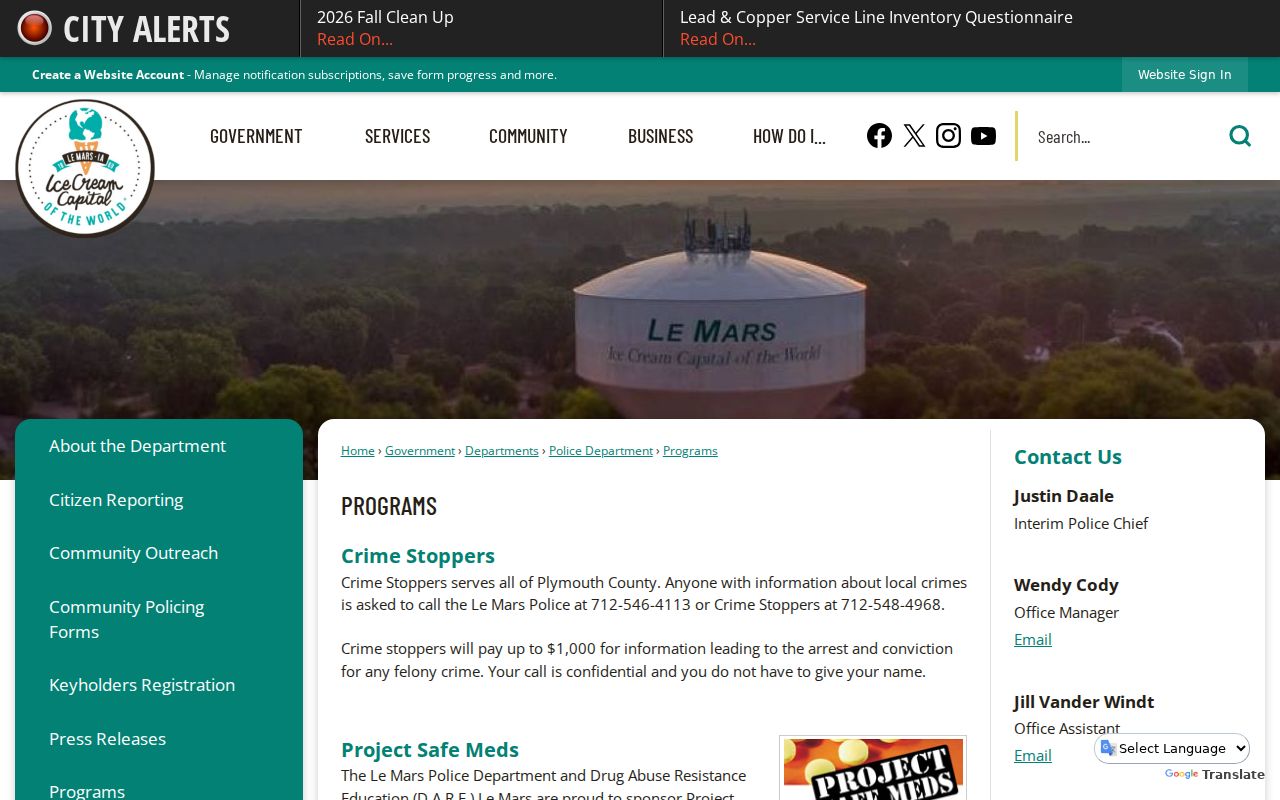
The Le Mars Crime Stoppers program page serves all of Plymouth County. It publishes the tip line 712-548-4968, states that no name is required for a confidential tip, and describes a possible reward of up to $1,000 for information leading to a felony arrest and conviction. Those are the program's published conditions, not a promise that every tip earns a payment. The page itself carries no roster, only the tip route.
Crime Stoppers is not the sheriff's Most Wanted database, a court-record search, or a self-surrender channel. If you are trying to resolve your own warrant in Plymouth County, contact the clerk, sheriff, counsel, or the issuing agency instead of sending personal case facts as an anonymous tip.
How Most Wanted Differs From an Active Warrant
A Plymouth County Most Wanted entry, an active warrant, and a custody record answer three different questions. Keeping those distinctions clear stops a public program from being mistaken for a full court database.
| Source | What It Shows | What It Cannot Prove Alone |
|---|---|---|
| Most Wanted program | A curated sheriff presentation with an accuracy warning | That every active warrant is listed or that omission means clearance |
| Iowa court docket | Public case events, filings, appearances, and orders | Every restricted law-enforcement status or sealed fact |
| Active warrant | A current judicial order authorizing arrest | Conviction or final disposition of the underlying allegation |
| Inmate roster | A dated custody record | That a warrant remains active after booking or release |
For a wider view of outstanding records, the Plymouth County active warrant search sorts out court and agency channels. It does so without reproducing any named list.
Plymouth County Inmate Roster Difference
The Plymouth County sheriff posts dated PDF links on its inmate roster page. That archive tracks custody, not warrants. It cannot stand in for a countywide warrant search. An arrest may grow out of an active warrant, a fresh charge, a probation action, or some other process entirely. A person can walk free while the case still calls for a hearing or another court step. So treat the roster as a snapshot of who is held, nothing more. Names and photos from it travel poorly too, since the list ages fast and custody is easy to mistake for warrant status. If you are checking on yourself, find the court case and ask the clerk which docket event controls. Checking on a relative works the same way. Use the official route with their permission, and keep private case details off public boards.
Plymouth County Most Wanted Record Limits
The public program interface stops short of what a warrant check really needs. It does not carry a universal warrant number, case number, bond amount, issuing court, judge, or holding agency. There is no active, cleared, or recalled filter either. Card-level detail on individuals is left out of Plymouth County's public view.
| Program Type | Curated Plymouth County Sheriff Most Wanted presentation. |
|---|---|
| Search Controls | No public name, case, city, offense, status, or date filter located. |
| Completeness | No countywide full-database claim or downloadable warrant file located. |
| Update Cadence | No fixed public schedule located; use the live official page. |
| Accuracy Notice | The sheriff warns of possible errors and provides an office correction route. |
| Case Resolution | Bond, recall, court, and status require confirmation with the clerk or responsible agency. |
These limits argue for confirming, not guessing. Juvenile, sealed, protected, and pre-execution records also sit outside public view in Plymouth County.
When You Believe You Are Listed
If a Plymouth County listing looks like yours, do not call Crime Stoppers about your own warrant. Do not walk into an agency blind, either. Learn what the court and the enforcing office require first. Search the public Iowa court case, call the Clerk of District Court, and talk with an Iowa attorney if arrest risk or criminal consequences seem unclear. The clerk explains procedure, but cannot give personal legal advice.
- Write down the case ID, citation number, court, and latest docket event you can confirm.
- Call the Plymouth clerk and ask whether the warrant is active and what appearance, payment, motion, or court order is required.
- Ask whether bond is allowed and whether a judge must act. Do not infer an amount from a statewide schedule.
- If surrender is required, confirm location, hours, identification, booking, bond, and next appearance with the sheriff or jail.
- Keep proof of payment, bond, appearance, and any recall or quash order, then recheck the official record.
Do not approach a listed person: For your own status, contact the court, an attorney, and the Plymouth County Sheriff through verified official channels.
Plymouth County Official Confirmation
For a Plymouth County warrant check, the public court route is Iowa Courts Online. It shows public case history. Warrant details are not all guaranteed there, though. Older records may take a courthouse terminal or a call to the clerk. The sheriff also takes public-record requests by phone, mail, email, or in person through its public-records page. Name a specific case, document, and date range when you ask. The restricted IOWA System serves criminal-justice agencies, not the public. Police pages for Le Mars, Remsen, Akron, Kingsley, and Hinton offer no full public warrant databases either. So confirm directly. A blank search, absence from Most Wanted, or an old roster entry does not settle the current legal question.
Note: Use the court for the docket, the sheriff for its program and enforcement route, and Crime Stoppers only for tips.